
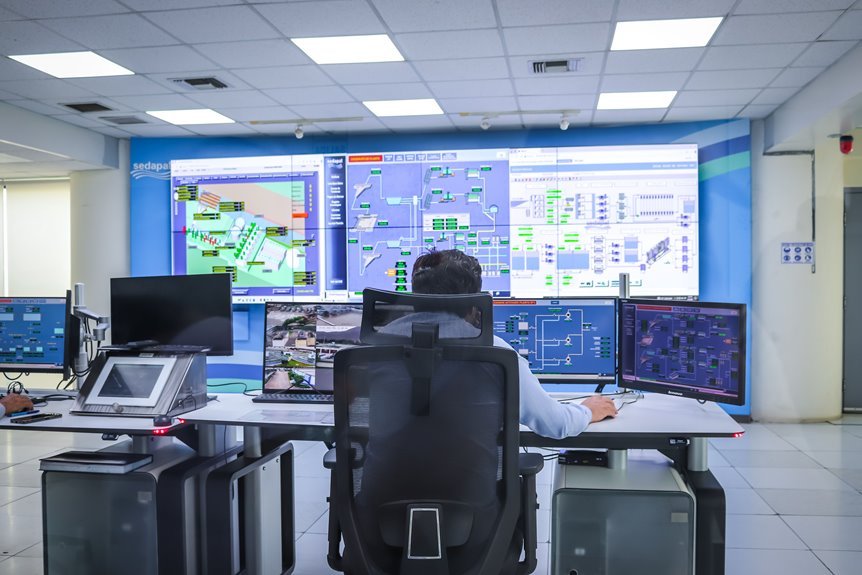
Enterprise Network Flow Monitoring and Evaluation centers on structured telemetry to quantify traffic patterns across the IT estate, translating volume, entropy, and session metrics into actionable insights about latency, errors, and top talkers. It emphasizes objective measurement, anomaly detection, and governance, while pursuing data minimization and privacy safeguards. The approach supports policy-driven remediation and automated responses, balancing privacy, compliance, and cost in large deployments. A disciplined, metrics-driven discussion awaits and implications for governance and performance await further scrutiny.
What Is Enterprise Network Flow Monitoring and Evaluation?
Enterprise network flow monitoring and evaluation refers to the systematic collection, analysis, and interpretation of data traffic patterns within an organization’s IT infrastructure to assess performance, security, and capacity.
The approach emphasizes objective measurement, anomaly detection, and governance.
It acknowledges privacy risks, pursues data minimization, tracks compliance thresholds, and avoids vendor lock in to maintain flexible, transparent security postures.
Core Metrics and Signals That Drive Visibility
What core metrics and signals enable comprehensive visibility into network activity and health? Core metrics include traffic volume, flow entropy, and session durations, complemented by signals such as latency trends, error rates, and top talkers.
Priorities: data accuracy, noise reduction, data retention policies, and anomaly detection to distinguish benign variance from structural changes impacting performance and security.
Practical Implementation: From Data Collection to Action
From the established metrics and signals, practical implementation translates those insights into a repeatable data pipeline: collection, normalization, correlation, and action-oriented governance. The process enables disciplined network optimization through structured telemetry, policy-driven responses, and automated remediation. Anomaly detection is integrated with baseline behavior, enabling rapid triage, evidence-based decision-making, and continuous improvement within a controlled operational framework.
Balancing Privacy, Compliance, and Cost Efficiency in Large Deployments
Balancing privacy, compliance, and cost efficiency in large deployments requires a structured approach that aligns data governance with operational economics. The analysis emphasizes privacy governance frameworks, selective data retention, and minimization of shared telemetry to reduce exposure.
Cost optimization emerges via automated policy enforcement, scalable tooling, and lifecycle-aware provisioning, ensuring compliance while preserving performance, flexibility, and organizational autonomy.
Frequently Asked Questions
How Often Should We Refresh Network Flow Baselines?
Refresh cadence should be aligned with observed baseline drift, typically quarterly to semiannually. Regular reevaluation responds to gradual changes, ensuring baselines remain representative; excessive frequency risks noise, while infrequent updates permit undetected shifts impacting anomaly detection and performance.
Which Vendors Offer Best-In-Class Flow Data Encryption?
Vendors encryption offerings vary; several vendors provide advanced flow privacy through robust envelope encryption and at-rest protections, ensuring data remains confidential during transit and storage. The analysis highlights strong standards, interoperability, and risk-aligned, auditable encryption controls.
What Are Typical Hidden Costs in Large-Scale Deployments?
Hidden costs arise from baseline refresh, traffic integrity overhead, and ongoing maintenance; hidden costs, baseline refresh, traffic integrity, anomalous traffic, non user initiated, and encryption management. The analysis confirms that these factors frequently affect large-scale deployments.
How to Ensure Flow Data Integrity During Peak Loads?
Ensuring integrity during peak load relies on deterministic flow sampling, buffering, and checksums. Peak load strategies include burst protection, rate-limited ingestion, and data invalidation safeguards, ensuring consistent ordering, timestamp accuracy, and resilience against transient congestion.
What Are Signs of Anomalous, Non-User-Initiated Traffic?
Could anomalous, non-user-initiated traffic appear as sudden surges, unusual destinations, or atypical protocol usage, suggesting off topic discussion and unrelated topic behaviors in the data? It signals potential command-and-control, beaconing, or malware activity, warranting investigation.
Conclusion
Enterprise Network Flow Monitoring and Evaluation yields objective visibility into traffic, latency, and anomalies through standardized metrics and governance. By integrating core signals—volume, entropy, and session duration—organizations can quantify performance and drive policy-driven remediation. The approach emphasizes privacy-preserving data minimization and selective retention to balance compliance and cost. Implementations favor automation and continuous improvement. In sum, a disciplined, data-driven framework delivers actionable insights; think of it as a spreadsheet-era spanner for modern networks, precise yet adaptable.
