
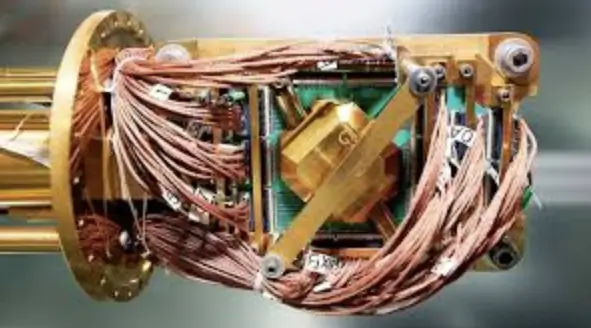
Quantum computers store information in qubits, which can be in superpositions of 0 and 1 and become entangled with one another. This allows computations to explore many possibilities simultaneously, unlike classical bits. Quantum gates manipulate these states, forming circuits that execute steps in a defined sequence. Real machines face noise and errors, requiring error correction and fault-tolerant design to preserve information. The balance of fidelity, resources, and control shapes practical progress and the potential for new capabilities. The next pieces of the puzzle are waiting to be explored.
What Makes Quantum Computers Different From Classical Ones
Quantum computers differ from classical ones in how they process information. They use quantum hardware to store and manipulate information with qubits, enabling parallel exploration of possibilities. This changes problem-solving approaches and performance expectations.
Cryptographic implications arise as certain tasks become easier or harder. Compared to classical systems, outcomes hinge on measurement and probabilistic results, shaping security assessments and freedom to innovate in computation.
How Qubits Create Superposition and Entanglement
Qubits create superposition and entanglement by leveraging fundamental quantum properties that have no classical analogue: a qubit can represent both 0 and 1 simultaneously, and multiple qubits can exhibit correlations that persist even when separated.
Superposition pitfalls caution against assuming classical bitness, while entanglement misconceptions arise from local intuition; nonetheless, these phenomena enable powerful, nonlocal correlations guiding quantum information processing.
Quantum Gates and Circuits: Building Computations
Gate-based quantum computing organizes computation through sequences of quantum operations called gates, which transform the state of qubits in precise ways.
Gates compose circuits that execute algorithms, with circuit depth indicating sequential layers of operations.
Practical design minimizes quantum error by using robust gate sets and parallelism, balancing fidelity, timing, and resource constraints to enable reliable, interpretable computations.
Error Correction and Practical Challenges in Real Machines
Error correction is essential because fragile quantum states quickly degrade through noise and operational errors. In real machines, error correction mechanisms must identify and rectify faults without collapsing superpositions, a delicate balance demanding redundancy and careful synchronization.
Challenges include hardware scalability, control precision, and fault-tolerant architecture trade-offs.
Progress shows practical schemes, yet implementation gaps demand robust, scalable designs for reliable quantum advantage.
Frequently Asked Questions
What Are Quantum Computers Useful for Today?
Quantum computers today assist in specialized tasks, including optimization and simulation of quantum systems, with attention to quantum error management and qubit coherence; progress remains incremental, supporting research, industry prototypes, and broader discussions about computational freedom and future capabilities.
How Long Until Practical, Scalable Quantum Advantage?
Practical timelines for scalable quantum advantage remain uncertain, with progress tempered by quantum scalability challenges. No, data privacy concerns persist while thought reading ethics spark debate; researchers emphasize incremental, evidence-based milestones toward usable systems for diverse, freedom-loving audiences.
Do Quantum Computers Read Your Thoughts or Data?
Quantum computers do not read thoughts or personal data; they process information encoded in qubits. Privacy concerns arise from potential data exposure during computation and storage, while data ownership remains with the user, though protections depend on implementation and policy.
What Are Physical Implementations Beyond Superconducting Qubits?
Alternative qubit platforms include photonic integration and hybrid quantum systems, addressing cryogenic challenges; researchers pursue noise resilient encodings and fault tolerance architectures, exploring diverse materials and interfaces to broaden practical implementations beyond superconducting qubits for freedom-driven, evidence-based progress.
How Is Quantum Computing Regulated or Ethically Managed?
Regulators ponder ethics governance and ensure regulatory compliance as quantum computing advances. The field balances innovation with risk, emphasizing transparent oversight, risk assessment, international standards, and clear accountability, while safeguarding privacy, security, and equitable access for responsible freedom.
Conclusion
Quantum computers, when understood clearly, reveal a technology that leukotomizes reality: superposition and entanglement become computational levers, not mysticism. By assembling tiny quantum gates into circuits, these machines perform certain tasks with bewildering speed, yet must battle noise and errors with increasingly sophisticated correction. The result is a carefully balanced dance—fidelity, resources, and control—where scalable, fault-tolerant designs push us toward genuine quantum advantage. In short, the future hinges on mastering nonclassical correlations to solve problems beyond classical reach.
